
Albany County Busted Booking Records
A booking happens after an arrest, not during it. Fingerprints get taken, a file opens, and the jail logs the person in. A charge may be listed, and a photo often joins the file too. None of that tells you how a case ended. Police can even skip the jail entirely: under New York Criminal Procedure Law §150.20, an officer can hand someone an appearance ticket and send them straight to court, so a police stop can produce a case with no Albany County Correctional Facility booking behind it. People also get booked, released, transferred, or brought before a judge before anything firm shows up online.
So where do busted booking records live? The Albany County Corrections page names the Albany County Correctional Facility, or ACCF, as the county jail. That's all it does. There is no public mugshot gallery there, no searchable roster, no date filter, and no promised photo-update schedule. A photo may sit in an agency file somewhere, but no verified official page lets the public browse county booking photos.
| Record field | What it can establish |
|---|---|
| Arresting agency | Which police department or office is the likely original record holder. |
| Arrest and booking dates | Two different events that should not be treated as one date. |
| Booking or inmate number | A useful request reference if the custodian confirms it is releasable. |
| Charges as booked | Initial charges that can be amended, reduced, dismissed, or resolved later. |
| Custody and facility status | A time-sensitive status question, best checked through the official custody channel. |
| Court and disposition | The later case path and official outcome, rather than an intake label. |
Note: For the later legal result of any case, check court records or a Certificate of Disposition.
Request Albany County Busted Records
Want a record from ACCF or the Sheriff? File through Albany County NextRequest and name the Albany County Sheriff's Office or ACCF as the custodian. Keep it tight. Give the full name, a rough date, the arresting agency, and any booking or incident number you have. Ask for whatever booking record and photograph can be released, choose electronic delivery if offered, and tell the agency it may redact protected details rather than withhold the whole file.
The state's rules come from the FOIL statute. It allows exemptions for privacy, active law-enforcement work, and other protected material. The Committee on Open Government says an agency generally has five business days to grant, deny, or acknowledge a request and give an approximate date. That clock is not a delivery promise. Paper copies can cost up to twenty-five cents a page, and other media may carry lawful reproduction costs. No fixed ACCF booking-photo fee or turnaround exists.
- Identify the agency that made the arrest before selecting a records route.
- Describe the requested record by person, approximate date, agency, and available event number.
- Ask for a releasable electronic copy and a fee estimate before processing.
- Read any redaction or denial notice, then use the listed appeal process if appropriate.
- Booking
- Facility or agency intake after custodial arrest.
- FOIL
- New York’s process for requesting records held by a government agency.
- Disposition
- The court’s later resolution of a criminal case.
- Sealing
- A legal restriction on access to records that can follow certain case outcomes.
Note: A custodian can decline to build a new roster or run an open-ended countywide search when your request pinpoints the record.
Albany County Busted Photo Rules
FOIL opens the door to agency records, but it does not turn every booking photograph into a public web asset. A record may come out in full, come out redacted, get delayed, or get denied under an exemption. Source and date count for a lot. A photo handed over in an official release is one thing; an unverified social media copy is another, and a third-party repost proves nothing about whether the agency still treats the item as current or releasable.
Sealing changes the picture. When a criminal action ends favorably, CPL §160.50 governs sealing of official records and identification materials. New York Courts also describes later sealing under CPL §160.59. An old index lingering online is no reason to republish a sealed matter. For any specific case, pull the court record or the order itself rather than trusting a stale page.
No verified New York statute forces third-party publishers to yank an accurate image just because someone demands it. Correction runs source by source. Get a court disposition or sealing order if one applies, ask the originating agency to fix its record, then approach the publisher through its stated process. RecentlyBooked and Mugshots.com each publish no-fee review policies for certain incorrect, sealed, or outdated material. Those are publisher claims, not government guarantees. And never pay an unverified service promising universal removal.
The RecentlyBooked policy page appears below because it lays out that publisher's own review route. It is not Albany County policy.
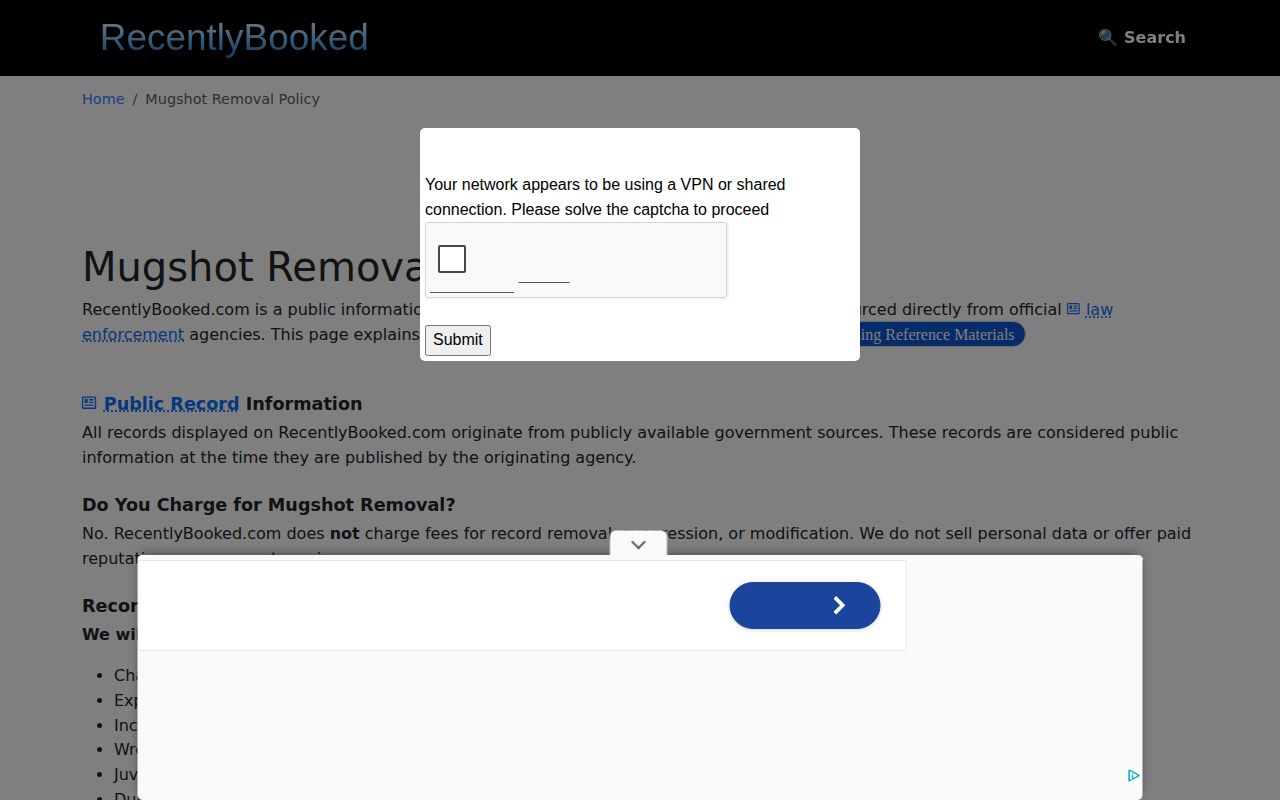
Start with the source. Google's outdated-content process only kicks in after a source page or image has been removed or materially changed; it will not touch a live source page.
Find Albany County Recent Arrests
Albany County has no verified public booking feed you can search by date, name, charge, or booking number. So work backward from who made the arrest. Albany Police, Colonie Police, Guilderland Police, the Sheriff, and other agencies each keep their own records. Wondering who is in county custody right now? Use the official corrections route and VINE. Wondering about a police incident? Ask that agency. For how a case turned out, go to a court source.
- Confirm the municipality or agency connected to the event.
- Check the official county custody-status route if detention or release is the concern.
- Use WebCriminal for selected court information and future appearances.
- Submit a focused FOIL request to the agency holding the desired report or photo.
- Use an unofficial index only as a lead, then verify names, dates, agency, and status with an official source.
WebCriminal is not a booking database. New York Courts warns that a missing result can mean several things. The case may be sealed, or treated as a youthful-offender matter. It may not be entered yet, or no future appearance may be set. Once a case closes, the Certificate of Disposition states the outcome. The same countywide record path also covers Albany city arrests, Colonie bookings and records, and Guilderland matters. Each police department may still hold the original event file, though.
Albany County Busted Custody Status
Custody questions start with the county corrections page. It sends the public to New York State VINE. VINE shows custody status and can send release alerts once you register. It does not display booking photos. The Albany County Correctional Facility sits at 840 Old Albany Shaker Road, Albany, NY 12211. Its main line is (518) 869-2600. For non-emergencies, the Sheriff's Communications Center lists (518) 765-2351.
None of the official pages publish the usual roster fields. That gap matters more than any guessed link or copied third-party interface would.
| Possible roster item | Verified official Albany County public availability |
|---|---|
| Name or inmate-number search | No verified public search tool. |
| Booking date, charge, bond, or agency filters | No verified public county interface. |
| Booking-photo thumbnail | No verified official public photo roster. |
| Same-day or weekly update window | No verified public schedule. |
| Custody or release status | VINE and official facility contact are the documented routes. |
Capacity and admissions figures differ across county facility summaries. The county pages do not explain why. Treat them as separate statements, not one current statistic. Custody status can also shift faster than any summary page updates.
Note: Someone released from custody may vanish from a status system while an agency or court record still exists.
Albany County Booking-Feed Windows
Albany County has no official booking-photo feed on its public pages. That includes same-day, 48-hour, 72-hour, weekly, and historical ACCF versions. The gap is about access. It is not proof that the Sheriff keeps no internal operational records. Albany Police, Colonie Police, and Guilderland Police do not post a county-style photo roster either. Their agency pages, records offices, and FOIL routes remain the documented alternatives.
| Time period sought | Official route | Limit to remember |
|---|---|---|
| Current custody | VINE or ACCF contact | Status is not a public photo feed. |
| Recent police event | Arresting agency or focused FOIL request | Some events result in appearance tickets, not bookings. |
| Selected local reporting | WNYT, Times Union, or Spotlight News | News coverage is selective and not a roster. |
| Historic local material | Albany County Hall of Records | Archive material is not current custody data. |
RecentlyBooked's Albany County page is a third-party index. It carries a changing update marker and booking-style fields when available. Being secondary, expect lag. Expect listings that persist after release, and normalized fields too. Mugshots.com's county archive skews toward older years, roughly 2012 through 2019. It is not a same-day feed. Neither one is the county's official roster.
Albany County Busted Records Beyond ACCF
County jail custody, state prison, federal custody, and civil immigration custody are four different systems. Match the channel to the person's status. The NYS DOCCS lookup searches state-custody identity, status, and location. You can query it by DIN, NYSID, or name and birth year. It covers state-sentence custody only. The service does not promise a booking photo. Nor is it a substitute for a local ACCF intake search.
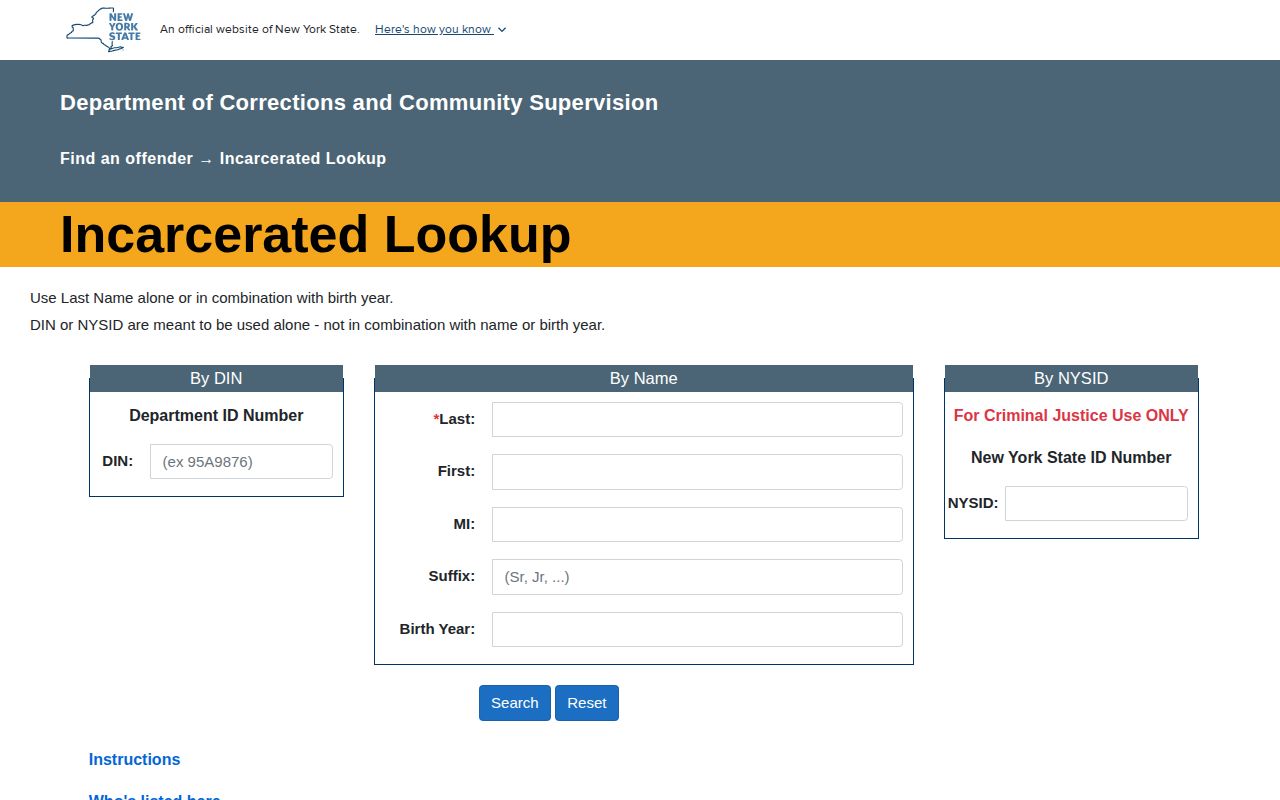
Federal custody sits outside county hands. Sentenced federal inmates show up in the Bureau of Prisons inmate locator, though that tool is a locator, not a mugshot gallery. Civil immigration custody works differently again. The ICE Online Detainee Locator System has its own identity requirements and its own coverage rules. A federal pretrial detainee may not appear in BOP at all. No current ICE contract at ACCF is confirmed here, so treat that question as open.
Historic Albany County Busted Images
Older records are a different hunt, and Albany has an unusual one. The Albany County Hall of Records holds jail-related materials plus a Bertillon Criminal ID card collection from 1892 to 1917. Its finding aid describes roughly 13,708 photographic identification cards and glass-plate negatives. This is an archive of an early identification system. It is not a place to find recent arrests or current custody. A Times Union feature about the Hall of Records collection adds helpful history.
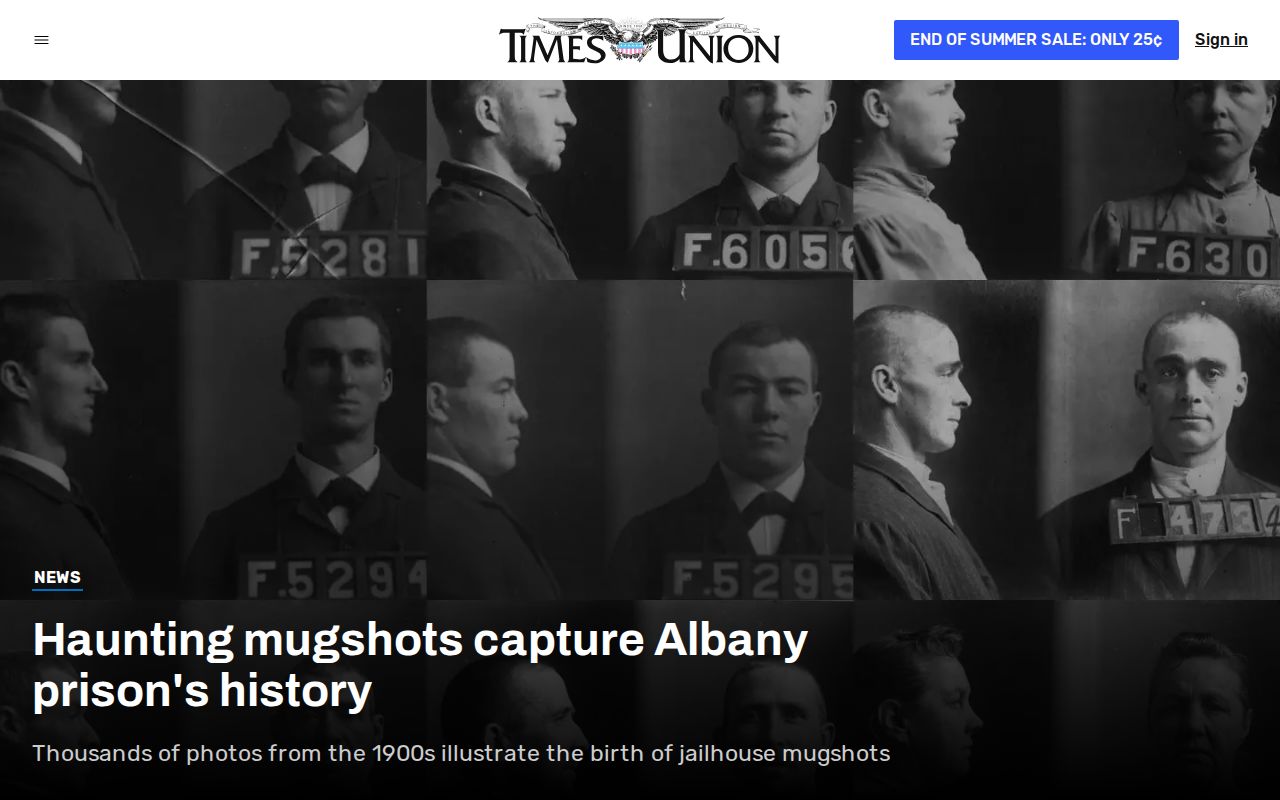
Archival research carries its own costs. The Hall's request form lists a $20-per-hour search fee with a one-hour minimum, plus an optional $4 certification. Those charges cover historical research only. They do not apply to any current ACCF booking-photo FOIL request.
Albany County Busted Mugshots by City
City-level pages help you figure out which police department likely wrote the initial report and how local records requests work. County detention is still a separate question. Albany is the county seat. Colonie is a town that contains the ACCF area, and Guilderland is a town as well. The labels change nothing about the official-source rule: go to the agency that created the record first, then to ACCF, VINE, or the court when the next event requires it.
- Albany Busted Mugshots: Albany Police records, city FOIL, and the potential ACCF custody path.
- Colonie Busted Mugshots: Colonie Police records and the town’s direct relationship to the ACCF location.
- Guilderland Busted Mugshots: Guilderland Police records hours and the Town Clerk FOIL handoff.
A possible warrant or wanted notice is its own question, and the court or issuing agency is the place to confirm status. Albany County warrant-check information covers why the County Clerk's broader records search cannot serve as a real-time countywide warrant confirmation tool.
Albany County Busted Arrest Statistics
Numbers add context, but a statistic is not a roster. The New York State Division of Criminal Justice Services 2023 county table reported 5,592 adult arrests in Albany County. That total includes 2,371 felony arrests and 258 prison sentences. These are fingerprint-supported county figures. They are not ACCF booking totals, they identify no one, and they say nothing about who was held, released, or prosecuted.
The gap matters most where an appearance ticket is possible. An adult arrest count cannot be converted into booking photos, a current inmate list, or a claim about guilt. County corrections and Sheriff pages also publish conflicting facility-summary numbers. Neither page says which definition or date controls, so no single figure wins here. For a current question, status beats statistics every time. VINE and the right agency answer custody and release; the arresting agency, a FOIL response, or a court record answers the rest. Statistics work best as a county-level view of reported activity, never as a substitute for a person-specific record.
Albany County Booking Court Follow-Up
Two questions come up after someone is booked in Albany County. Where is the person now, and what happened to the case? A busted roster or booking log helps with the first. Court papers answer the second, and they live somewhere else entirely.
New York Courts runs a WebCriminal service that lists criminal case details and upcoming appearance dates for selected courts. It has limits worth knowing. A case might be sealed, involve a youthful offender, lack any future court date, or simply not be keyed in yet. The County Clerk's online-records page is a different tool with a different job. Treat it as its own thing rather than a full criminal-case feed.
Once a case wraps up, the document that matters is the Certificate of Disposition. It names the charge, the outcome, the date, and the sentence. Booking paperwork can't do that. A charge listed at intake may later be reduced, amended, or dropped, and terms like "released" or "bail posted" say nothing about how things ended. When you need the final word, ask the local criminal court, Albany County Court, or whichever court took the case.
Sealing changes the picture too. A court order governs a record's current status, not an old index page. If a record has been sealed or corrected, follow the correction path for that specific source instead of treating a historic listing as the last word.
Albany County Busted Record Retention
There is no single clock for how long busted records stick around. The New York State Archives publishes the LGS-1 retention schedule, which covers local-government record series including individual identification files and some digital mugshot material. But a schedule is not a promise that any particular ACCF photo still exists. How long something is kept can hinge on the record series, the offense category, local adoption, a system migration, an archival appraisal, a legal hold, or later sealing. Ask the agency whether it actually retains the record you want. Don't assume a photo must survive for a fixed number of years.
Who holds what depends on age. ACCF or the Sheriff keeps current booking-related county records. Older local material sits with the Hall of Records, which charges its stated archival research fee. New York State Archives holds many prison records, often without a name index. NYS DOCCS serves as the current state-custody locator. Keep these paths separate. A historic archive cannot tell you where someone is today, and a custody locator is not a photo archive.
One more mismatch comes from the web itself. A news article or third-party index can stay searchable long after a court seals a record or an agency fixes an error. When an official order changes a record's status, work through the court, agency, and publisher correction channels. An old copy that lingers in search results does not reflect the current legal status.
Keep your request tight before you send it. Describe one narrow event. Save whatever the agency sends back. That habit pays off when the first source comes up empty, since you can still tell apart an arrest record, a facility file, a court event, and an archive result from what you already hold.